Reproduced with the kind permission of Dr John Holiday:
YESTERDAY’S NEWS no. 48
THE ‘NEW’ HEYLIPOL CHURCH: part 1
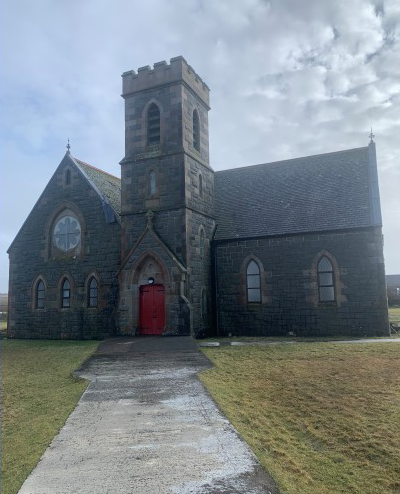
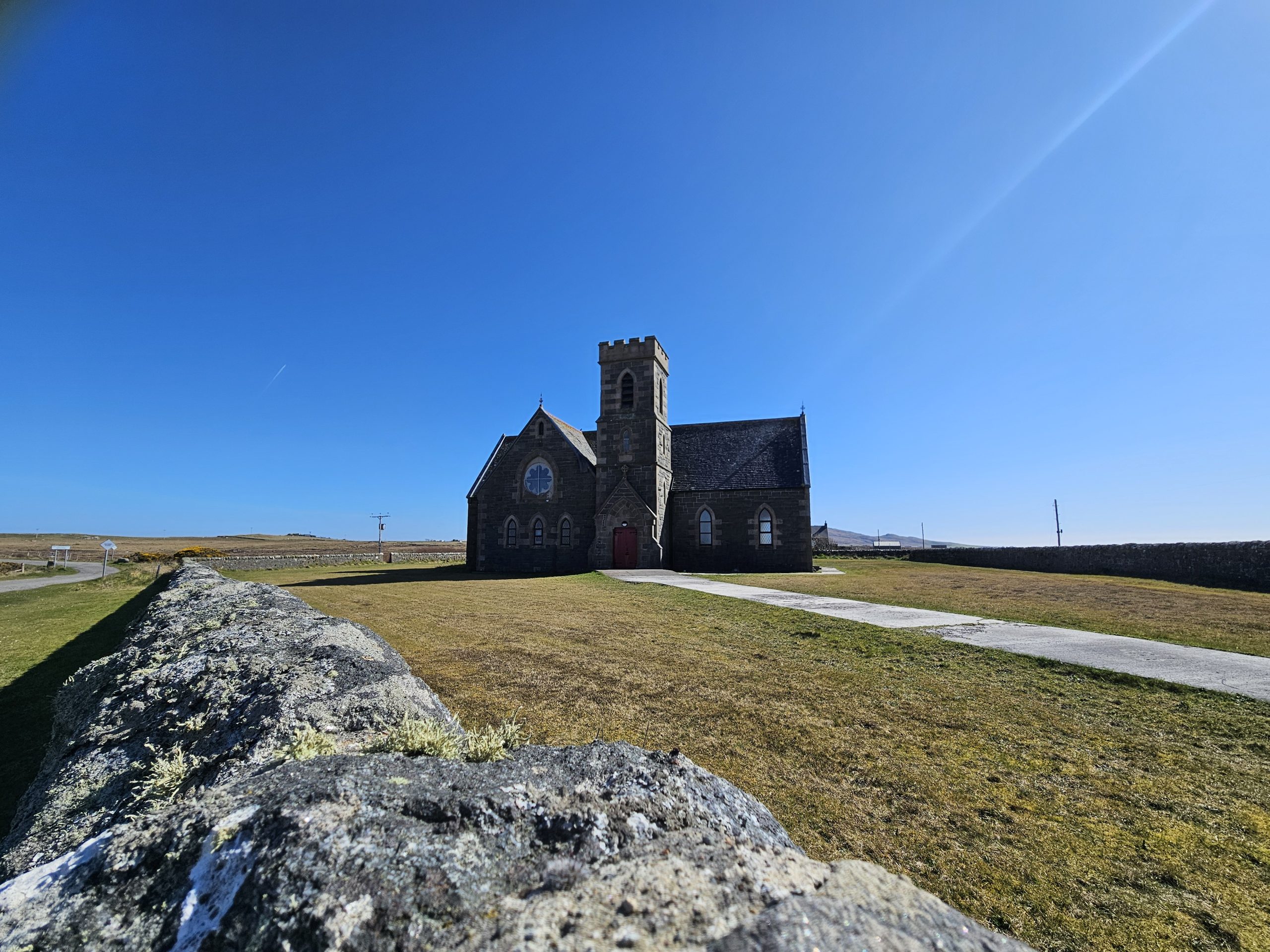
Eaglais na Mòinteach, Heylipol Church, is at a crossroads, literally and figuratively. The 123-year-old building is creaking at the seams, and supporters have formed the Heylipol Community Trust to decide the best way forward.
There has been a church on the site—on the frontier-lands of Heylipol, Moss and Barrapol—since 1843. The galleried ‘old’ Heylipol Church was said to have seated 600 worshippers. The ‘heritors’—landowners of heritable property within the parish—had an obligation to foot the bill, depending on the size of their holdings: the seventh Duke of Argyll put in £470, Hugh MacLean of Coll £180, and the Campbells of Caolas and Cornaig £31. (This information comes from Gordon Scott’s excellent chapter in the book The Secret Island.)
Less than sixty years later, however, it was obvious that a replacement was needed. The summary of a 1900 record in the Inveraray archives reads: ‘Heylipool Parish Church, Tiree.
Front elevation, section and ground plan with detail of decayed beam and proposed iron plate fixing’ (GB 3452 ARG/12/01/324).
In March 1901 the Heylipol congregation met. A decision had been taken: “This is the last communion in the church … A meeting of the congregation of the parish of Hylipol was held in the church on Monday last. The [minister] Rev. [Dugald] MacLean presided, and he was supported by Lady Victoria Campbell [the aunt of the ninth Duke of Argyll, the eighth Duke having died the previous year]; Rev. MacFarlane, Morven; Mr MacDiarmid, factor; and others. The business of the meeting was to consider what step was to be taken for building a new church in Hylipol. The meeting was opened by singing a psalm. Prayer was offered and a chapter was read by the Rev. chairman, after which the Rev. MacFarlane urged the congregation to carry on the work ungrudgingly … [The Tiree congregation] was the largest Gaelic congregation in [Argyll]shire, and all should unite in carrying the great work in view to a successful end … Everyone who knows the Church will agree with me that it is far from being what God's house should be. Since Mr MacLean became pastor, more than £300 had been spent on it, and before the Church could be properly renovated, it would cost more than that … The late Duke helped the congregation immensely, sparing neither money, time nor labour in the good work of repairing a house in which to preach God's gospel’ (Oban Times and Argyllshire Advertiser, 30 March 1901, p. 3). A William MacKenzie was appointed architect. This is likely to have been William MacKenzie of Dingwall, who designed a number of churches and manses around the Highlands, including the Kyle of Lochalsh Free Church. It is sometimes said that Heylipol’s design is based on Iona Abbey, but this is not obvious, and an experienced church architect had plenty of other places from which to draw inspiration. MacKenzie had another string to his bow:
‘In 1890, the first [Ross-shire] County Council appointed Mr MacKenzie to the position
[County Sanitary Inspector] he held up till the time of his death … A few years ago, he received high commendation for his excellent services in an alarming outbreak of smallpox in the county. An architect by profession and a partner in the firm of MacKenzie & MacDonald, Dingwall, Mr MacKenzie enjoyed wide prestige. His buildings are scattered over a wide district, and among them is the Church of Scotland, Castle Street, Dingwall’ (Northern Chronicle and General Advertiser for the North of Scotland, 16 March 1932, p. 5).
‘The contract for the erection of the [new] Hylipol Church has been given to Mr Hugh MacDougall, Oban, and he has sent some workmen to begin the building. The church is to be built in a modern style, and will be one of the finest in the Inner Hebrides when completed’ (Oban Times and Argyllshire Advertiser, 19 April 1902, p. 6).
‘A steamer [puffer] from Glasgow brought some freestone cement and other building material for the Hylipol Church. The steamer was beached on the sandy shore, and the material carted to the scene of operations at Hylipol. The old church has now been pulled down, and the work of erecting the new one will commence directly, as the masons and hewers [a lesser paid worker who shaped the stones that were then laid by the stone mason] have arrived from Glasgow and Oban. There is to be a transept and nave in the new [cross-shaped] building. [It may have been condemned, but] the old church was rather a stiff job to pull down’ (Oban Times and Argyllshire Advertiser, 24 May 1902, p. 6).
The ‘memorial stone’ for the new church was laid by Lady Victoria in August 1902 (Highland News, 16 August 1902, p. 3), and the building was opened in April 1903:
‘The fine new church of Hylipol was opened for divine worship last Sunday by the Very Rev. Dr. MacLeod of Inverness. The church was filled with people from all parts of the island, and the rev. doctor preached an eloquent and impressive discourse from the 100th Psalm, and made very suitable reference to the new building, which was now opened for divine worship. He desired most heartily to congratulate them on the erection of that beautiful and appropriate church. When its erection was first proposed, it certainly appeared to be a somewhat formidable, if not hopeless, undertaking, but through the zeal and enthusiasm of his dear friend, their minister, in which they had all co-operated, every difficulty had been overcome, and they had now the immense satisfaction of assembling themselves together in a House of God which seemed to him to be in all respects worthy of the sacred use to which it had been solemnly dedicated on that joyful day. It was only an example of what was going on in all parts of the country. The reviving strength of the Church of Scotland had been manifested in many ways. He hoped that it was observable in the religious conduct of the people, in their growing spirituality and in their readiness to take part in the great work of the Christian evangelisation which had been entrusted to them, both at home and abroad. But there were other tokens, he admitted, of a more material nature, which were also worthy of being noticed … The contractor for the whole building is Mr Hugh MacDougall, builder, Oban. Needless to say, this building reflects great credit on his work’
(Oban Times and Argyllshire Advertiser, 4 April 1903, p. 2).
Caption: Drawn postcard of the new Heylipol Church.
The following year, the church received a striking gift:
‘[Lady Victoria Campbell’s] ambition to reproduce in wood the beautiful Celtic tracery found on tombs and monuments throughout the Highlands has already, in large measure, been realised. A permanent result of this idea can be seen in the new parish church of Hylipol.
This consists of a handsome oak pulpit gifted to the church, the six panels of which show the finest of Celtic designs carved by Tiree boys’ (Aberdeen Press and Journal, 12 February 1904, p. 7).
Next time we will consider an important question: who paid for this ‘fine new church’?