YESTERDAY’S NEWS no. 49
THE ‘NEW’ HEYLIPOL CHURCH: part 2
Last time, we looked at the re-building of Eaglais na Mòinteach, Heylipol Church. There was no disagreement about the fact that a new church was necessary. But who would pay?
In 1875, the parish of Tiree was split into two. The east end was covered by Kirkapol, thewest by Heylipol. That meant Heylipol was now quoad sacra (from the Latin ‘concerning sacred matters’), meaning it no longer represented a civil parish. In turn this meant that the congregation could no longer rely on the ‘heritors’ to foot the bill. However, when the congregation met to discuss the project in 1901,
‘Lady Victoria Campbell spoke briefly, remarking that it gave her much pleasure to lend a hand in the work. She was sure her brothers, the [ninth] Duke of Argyll and Lord Archibald Campbell, would help the building as well as they could. Mr MacDiarmid [the Tiree factor] mentioned the expenditure on the Church by the late [eighth] Duke of Argyll. He was sure the present Duke would do his best because all the Dukes were taking much interest in the Church of Scotland. A committee was appointed to carry on the work as follows: Lady Victoria Campbell, hon. convener; Rev. Dugald MacLean, parish minister, convener; Mr Hugh MacDiarmid, vice-convener; Mr George MacDonald, teacher [at Heylipol School], secretary and treasurer. A good number of other ladies and gentlemen were appointed as councillors and collectors. Our correspondent adds: Not many were present at the meeting, but upwards of £70 has been received … I trust our Tiree friends and others interested in the island will help us. Collectors are appointed in every township, and, however small the sum is, if it is given with a willing heart, God will bless it’ (Oban Times and Argyllshire Advertiser, 30 March 1901, p. 3).
As a visiting minister pointed out: ‘Within the past few years, no fewer than six new churches have been erected within the bounds of the Mull Presbytery alone. Two of these have been built in Morven, one in Tobermory, one in Salen, one in the parish of lona and one in Tiree. When it is remembered that these have, in every case, been erected by the voluntary efforts of ministers and people with little (and in some case no) assistance from heritors, it will be seen that there is no lack of life in the Church of Scotland in these parts’ (Highland News, 10 August 1901, p. 3).
Fund raising got off to a good start, both on the mainland and in the island: On the evening of Thursday 20 February, a concert of Gaelic and English songs in aid of the Building Fund of the Parish Church, Hylipol, was given in the Waterloo Rooms, Glasgow, when there was a fair attendance present’ (Oban Times and Argyllshire Advertiser, 1 March 1902, p. 2). ‘There met on Friday evening last in Cornaig Schoolroom under the auspices of Comunn Ceilidh Creag na Cathrach [‘the rock of the chair’ was a natural feature behind the Cornaigmore mill house], one of the most successful assemblies of the kind ever held in the Island of Tiree. This young, vigorous and enthusiastic Comunn brought their efforts for this year to a happy conclusion by holding a concert in aid of local funds for the erection of a new church at Hylipol. The spacious schoolroom was literally crammed to its utmost capacity, when [the factor] Mr MacDiarmid, Island House, was moved to the chair’ (Oban Times and Argyllshire Advertiser, 15 March 1902, p. 2). A fundraising bazaar was to be held in Glasgow with the same aim (Oban Times and Argyllshire Advertiser, 23 August 1902, p. 5) ‘The following statement has been circulated in connection with the church: " The members of Hylipol Parish Church have resolved, owing to the very dilapidated condition of the church, to build a new one, and for the purpose of helping to raise the necessary funds have decided to hold this bazaar … The Committees of the Church [of Scotland] have voted liberal grants on condition that the new church be opened free of debt on or before the 31st December 1902. His Grace the Duke of Argyll has given a donation of £100, and the parishioners—numbering 1200 and consisting entirely of crofters, cottars and fishermen—have subscribed £200. To complete the sum required for the erection of the new church, a balance of £800 has to be obtained by means of this bazaar’ (Highland News, 23 August 1902, p. 5).
Lady Victoria Campbell wrote in support from Geneva, where she was spending the winter: ‘May I intimate through your columns that a bazaar will be held in Glasgow under the immediate auspices of Mr MacLean's congregation, on behalf of the new church in Tiree of the quoad sacra parish of Hylipol, in the Waterloo Rooms on December 11th, 12th, and 13th … Knowing, as I do, the urgent need for this new church (as the old one was failing to keep the elements out), and that, after the Church [of Scotland] grants have been made and local subscriptions gathered, there is necessarily a deficit, I venture to ask your many readers to remember our needs in money or kind, as I am obliged to be away all this winter’ (Oban Times and Argyllshire Advertiser, 6 December 1902, p. 3).
The total sum raised by the three-day bazaar fell a little short of expectations at £508 (Oban Times and Argyllshire Advertiser, 20 December 1902, p. 2). But it was the quality of the goods on sale that attracted particular attention:
‘Now and again, as in the case of [Heylipol], a poor parish has to face the task of building a church, and has to appeal, and not in vain, to the rich members of the Church congregated in the cities, and chiefly in the city of Glasgow. But this, after all, is not the feature in connection with the Hylipol bazaar which makes it unique. It is the fact that the industries of the natives of that western island were exhibited for sale. This, we think, is a feature which may have far-reaching results. We are frequently told of the depopulation of the Highlands owing to economic causes, and to the poverty of the inhabitants, who, either of choice or necessity, remain in their native straths. Many who are deeply interested in the welfare of the crofters and fishermen who make a bare subsistence in these remote islands have for years been devising means by which their lot might be helped. It is not charity that is asked for, but initiation, a guiding of the people into new channels of industry, a fresh outlook which might entice them to new efforts, and an objective on which they might break their energies and help themselves. It is to the credit of those who are interested in this laudable movement that they have so far succeeded. Highlanders, it is found, are as adaptable as Lowlanders to their economic environment. If the Hylipol bazaar teaches us anything, it is the same lesson, and the fruits of new industries which were exhibited testify to the artistic taste and handicraft skill of the Celt, and point to fresh means of livelihood hitherto undreamt of’ (Oban Times and Argyllshire Advertiser, 3 January 1903, p. 3).
https://www.aniodhlann.org.uk/object/2013-140-1/
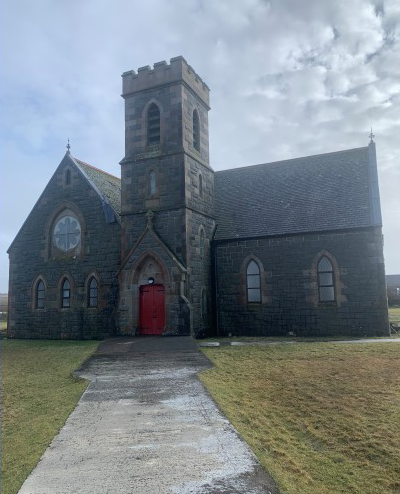
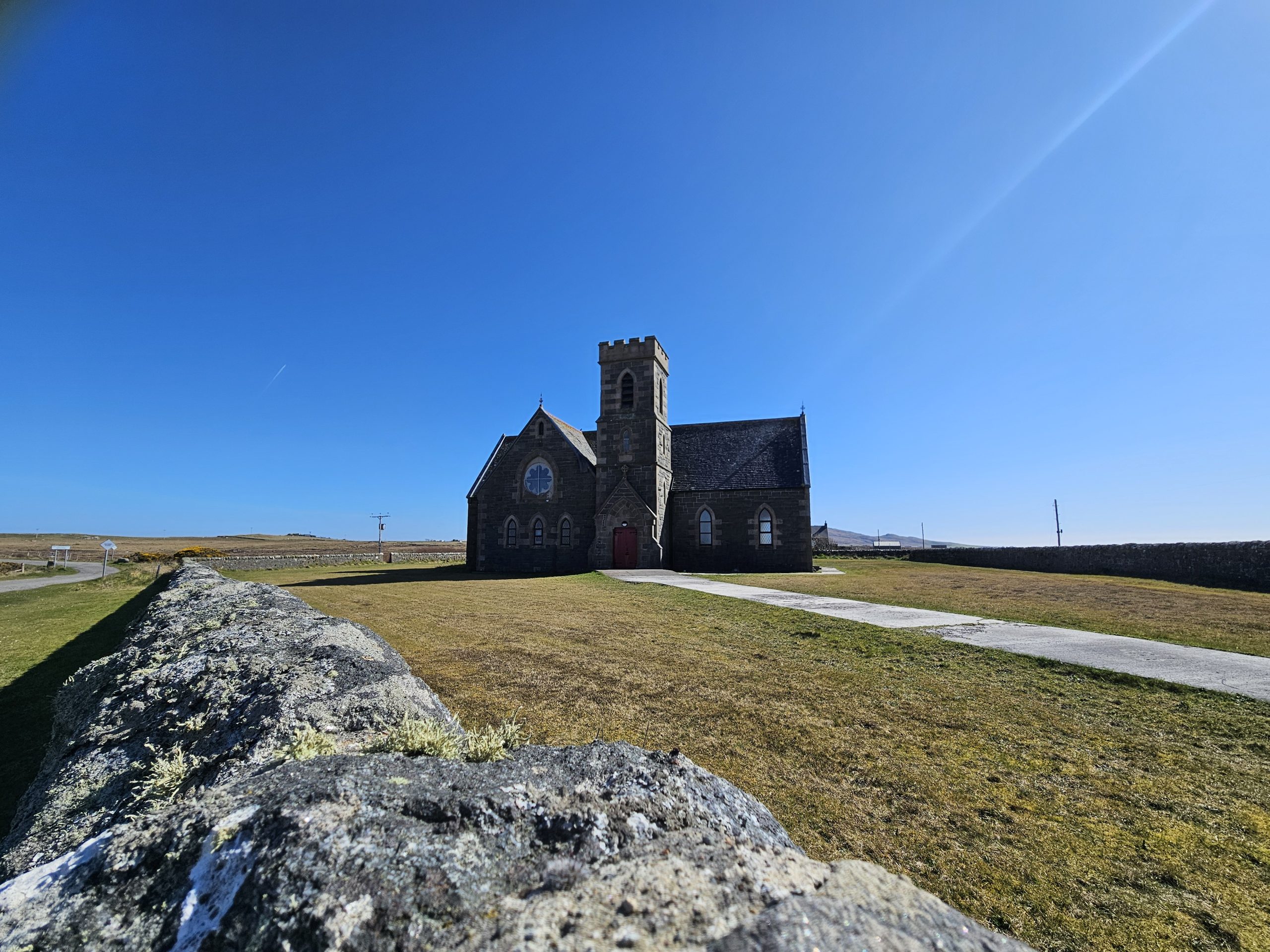
Heylipol Church around 1950
By 1903 the new church was ready: ‘The Presbytery of Mull met in the Church at Tobermory. Rev. MacGregor, Tobermory, as moderator presided. The report on the new church at Hylipol was submitted. The report bore that Revs. MacEachearn, Coll, and MacPherson, Tiree, had visited the church and certified that the building fully satisfied all the conditions on which grants are made by the Committees of the Church. The erection of this handsome building had made a valuable addition to the property of the Church within the bounds [of the Presbytery]’ (Oban Times and Argyllshire Advertiser, 26 September1903).
With some funds still to raise, a second bazaar was held in Glasgow: ‘The Very Rev. Dr Russell, ex-Moderator of the Church of Scotland, opened on Wednesday in the Waterloo Rooms, Glasgow, a sale of work organised by the congregation of Hylipol for the purpose of raising sufficient funds to clear off the existing debt on the church’ (Campbeltown Courier, 7 November 1903, p. 3).
‘The new Parish Church of Hylipol has been gifted with lamps by Mr George Eadie of Hampden Park, Mount Florida, Glasgow. [Possibly powered by paraffin] they are of a particularly handsome design, with wrought iron frames and copper fronts, and they supply light equal to one hundred candle-power each. Mr Eadie's munificent and useful gift earns the sincere gratitude of the Hylipol congregation, and it is understood that the Kirk Session have recorded their appreciation of his liberality’ (Oban Times and Argyllshire Advertiser, 19 March 1904, p. 3)
These newspaper cuttings on their own do not allow us to calculate the final total reached by the Hylipol Church Building Fund. We do know that the ninth Duke gave £100, the congregation £200, while the first Glasgow bazaar raised £508: a total of £808. We might add to this the collections from at least two ceilidhs and the proceeds of a second bazaar plus other donations. The splendid pulpit and lights were donated. I do not currently have enough information to calculate the cost of the project, but the 260-seater Salen Church was built in 1899 at a cost of £1300 (Mull Historical and Archaeological Society website). It is fair to say that a substantial proportion—and possibly most—of the construction costs for the new Heylipol Church were met by the congregation, the landlord and islanders living on the mainland.